
The Soil Maker ™
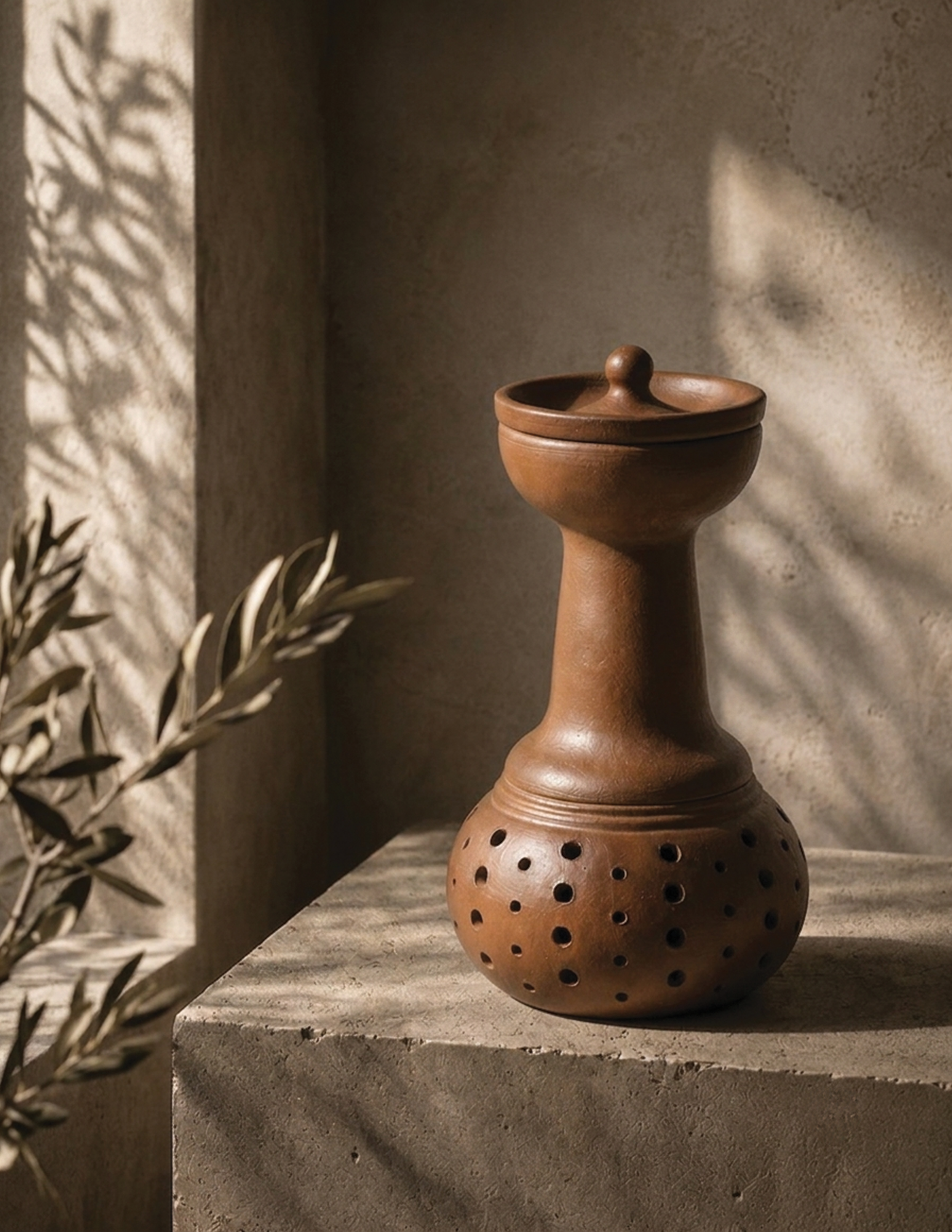
Exclusive Pre Sale Open Now (72 Units Available)
There Is No Such Thing
As Waste
Hi Friend,
What do you do with your food scraps?
If you're like most people, you scrape them into the trash after dinner and never think about them again.
Of course you do. That's what we've all been taught.
But here's the problem.
When food waste ends up in a landfill, it produces methane, a powerful greenhouse gas that contributes to climate change.
The average household throws away nearly 500 pounds of food waste every year, creating roughly 2,000 pounds of carbon emissions.
Now multiply that by every home on your street, every neighborhood, every city, every country…
It adds up faster than most of us realize.
The good news?
You didn't create this system.
You inherited it.
And because you inherited it, you also have the opportunity to pass on something better.
So, what legacy do you want to leave?
One where throwing food into the trash is simply “the way it's always been”?
Or one where your family becomes part of the solution?
What if your food scraps could become something beautiful?
They can.
We call it The Soil Maker, our Earth Alchemy Pot.
It's simple.
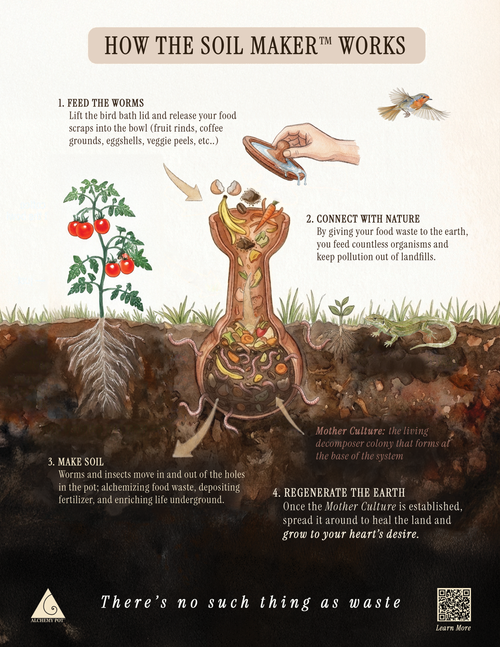
You bury it in your backyard and place your food scraps inside.
That's it.
Beneath the surface, billions of microorganisms go to work, transforming yesterday's leftovers into rich, living soil.
So instead of creating pollution…
You create life.
Healthy soil stores carbon, supports healthy plants, improves water retention, and helps regenerate the earth from the ground up. Many gardeners call it black gold.
Every banana peel, coffee ground, and vegetable scrap becomes an investment in the future instead of a burden on the planet.
And perhaps the most important transformation isn't happening underground.
It's happening within your family.
Children don't simply learn from what we tell them.
They learn from what they see us do.
Imagine your children growing up believing that nothing is truly wasted, that even what seems discarded can become the foundation for new life.
That's a lesson they'll carry forever.
The Soil Maker is handcrafted from durable stoneware, the same material archaeologists uncover thousands of years later.
This isn't another plastic compost bin that you'll replace in a few years.
It's something you can pass down.
To your children.
To your grandchildren.
To your great grandchildren.
One day, they may remember you as the ancestor who chose a different way.
Because lasting change doesn't usually begin with grand gestures.
It begins with the small choices we make every day.
The Soil Maker is more than a compost vessel.
It's a daily reminder that transformation is always possible.
That there is no such thing as waste when nature is allowed to do what it does best.
We're building a movement to teach humanity how to make soil, inside and out.
And it begins with you.
Our next pre order includes 72 Soil Makers.
Each one will be individually numbered, marking you as one of the first people to help bring this movement to life.
When you bring a Soil Maker home, you're not simply buying a product.
You're creating conversations after dinner.
You're giving your family a shared ritual.
You're helping regenerate the earth.
You're leaving a legacy.
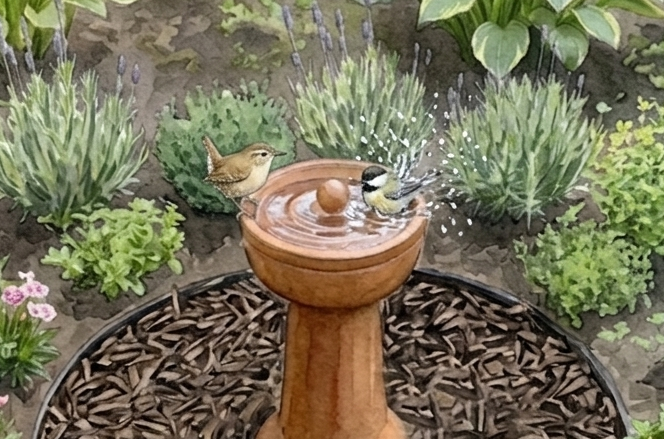
Oh, and the top also makes a beautiful bird bath.
The Soil Maker belongs in your yard.
Join the movement.
Pre order yours today,
and be here from the beginning.
The Soil Maker™
Activation Guide — Make your own culture.
A living system you bury in your yard.
The Soil Maker™ is a living system you bury in your yard. Handcrafted from stoneware, made in two pieces, and built to last generations, it works quietly underground, turning food scraps into rich soil for the garden growing around it.
This guide walks you through everything in order: where to put it, how to install it, what to feed it, what to expect over time, and how to maintain it once it's up and running. Every chapter is split into two parts — The Basics, which is everything you need to get it right, and Pro Tips, extra detail for anyone who wants to get the most out of it. Keep it nearby for the first year.
None of this is precise. The Soil Maker™ is easy and intuitive once you get a feel for it, and there's no way to truly mess it up — if something's off and it isn't digesting the way it should, you can always shovel out some of what's in there and start fresh. A little trial and error while you find the right rhythm is completely normal.
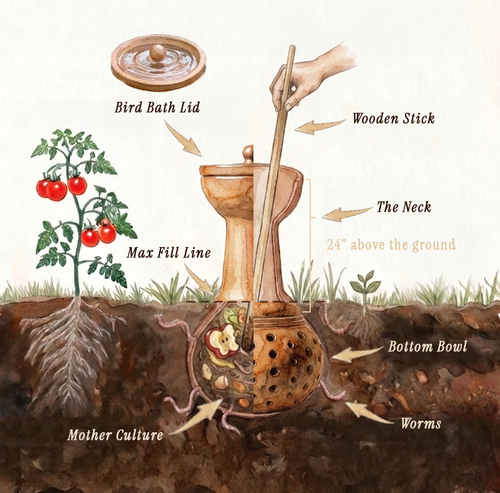
Two pieces. Half above ground, half below.
Five words worth learning before you install anything.
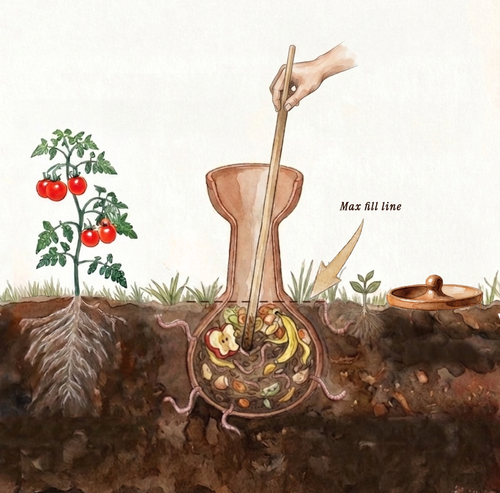
- The Bowl — the wide dish at the top, where scraps go in. Lift the lid, release your scraps, put it back.
- The Lid — doubles as a birdbath. Fill it with water any time. Keep it in place between feedings.
- The Neck — the narrow section between the bowl and the chamber. Scraps should never sit here — push them down with a wooden stick.
- The Chamber — the buried bulb where everything actually happens. This is the working part of the system.
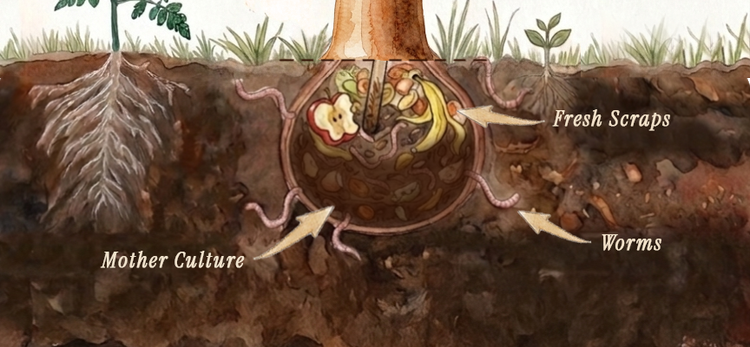
- Base Holes — perforations around the chamber. Worms and soil life move in and out freely — the system is a doorway, not a container.
- Mother Culture — the living decomposer colony that forms at the base of the system. It's what you harvest and spread.
Choosing Your Spot
Take a walk around your yard before you dig anything. Where you place The Soil Maker™ affects how it works, how easy it is to maintain, and what you can grow around it.
THE BASICS
- Keep it at least 8 to 10 feet from the trunk of any tree.
- Keep it at least 10 to 15 feet from any entry door.
- Pick a spot you'll actually walk to — daily, every other day, or at least once a week.
PRO TIPS
- If you're building a garden bed around it, leave 1 to 2 feet of clearance between the base of the vessel and anything you plant. The decomposition zone right around it is intense and ripples outward as it mellows — plant it at the center of the bed with everything else set back a foot or two.
- Closer to the door is fine if you don't mind insect activity near the house; further is fine if you'd rather keep more distance.
- It doesn't need to be tucked away. The middle of a lawn or even the front yard works well — think of it like placing a sculpture, easy to reach and pleasant to look at. The one exception is high-traffic areas like a lawn used for sports or kids playing, where you'll want it off to the side.
Digging the Hole
THE BASICS
- Use a shovel if your soil is already soft.
- If your soil is hard, compacted, or clay-heavy, use a pick to break it up first, then shovel out the loosened dirt.
- Dig the hole about twice as deep and twice as wide as The Soil Maker™ itself.
PRO TIPS
- You're not just making room for the vessel — you're loosening a wide area of earth around where it will sit. Dig down and out further than you actually need, then fill that loosened dirt back in before placing the vessel.
- Do the same on the sides. Loose earth on all sides makes it far easier for worms and other soil life to move in and start building their pathways to the buried chamber.
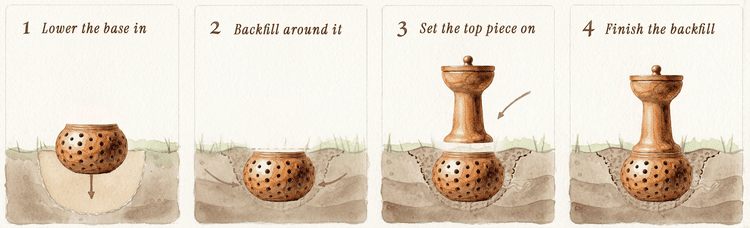
Installing The Soil Maker™
THE BASICS
PRO TIPS
- Aim to get the top edge of the bottom piece to sit about an inch below the surface — it gives the cleanest fit for the top piece.
- A little dirt falling into the chamber while you backfill is fine — just try to keep the inside of the chamber mostly clear rather than filling it up with soil.
Finishing Touches
THE BASICS
- Add about a foot of mulch, bark, wood chips, or stone around The Soil Maker™ and along the path leading up to it.
- Avoid planting directly at the base of the vessel.
PRO TIPS
- You'll be walking there often, so a defined path keeps that area clean and easy to reach — use mulch, stones, or a small gravel path to mark the walking area and separate it from anything you're growing nearby.

Starting the Culture
The Soil Maker™ relies on worms and microorganisms already living in your soil — they find their way in through the base holes on their own. But the fastest way to get going is to give the culture a head start on day one.
THE BASICS
- Get one can of red wiggler worms. You can find them at most nurseries or bait and fishing shops, or order them online.
- Before you add the worms, have a solid amount of food scraps ready; 1/4 - 1/3 of the bottom full, not just a banana peel.
- Add browns alongside your food scraps — plain cardboard with no ink, torn up, or a plain ink-free brown paper bag dropped in whole with scraps inside it.
- Add the worms and that first batch of scraps together, then keep feeding consistently from there.
PRO TIPS
- Aim for roughly a 50/50 ratio of browns to greens. The browns help keep air moving through the chamber, which keeps the culture healthy.
- You can skip the red wigglers and simply feed the chamber small, consistent amounts over the first few weeks instead. Worms already living in your soil will find their way in through the base holes as scraps begin to break down — it just takes longer to build an active culture this way.
What forms inside the chamber has a name: The Mother Culture™. It's the living mix of worms, microorganisms, and broken-down scraps that does all the work (and later on, it's what you'll be spreading out into the rest of your yard). It's similar to a sourdough starter, in that you feed it and spread it. More on that in Chapter 9.
Fill Level & Working the Chamber
In the beginning, you're building a culture, not filling a bin. Give it time to establish before you load it up.
THE BASICS
- It generally takes about a month before you really start to see things breaking down. Keep an eye on it, but don't be concerned if you don't see much change yet in the first few weeks.
- Food scraps should stay in the buried bottom chamber and never rise up into the neck of the top piece.
- As scraps pile up, use a stick to push them down and into the sides of the bottom chamber to make room.
PRO TIPS
- If you need to push scraps down further, lift the entire top piece off and set it aside for full access to the chamber. Use the stick to work scraps down into the sides more thoroughly than you can through the neck alone, then replace the top piece.
- There's no calendar to follow — you'll know it's time to empty and spread the Soil Maker™ Mother Culture when it actually starts to overflow, even after working the sides with a stick. Overflowing means it's ready, not that something went wrong. See Chapter 9 for how to harvest it.
What to Feed It
The Soil Maker™ thrives on the everyday — the things you'd normally throw away.
THE BASICS
Feed it: vegetable peels, fruit rinds, coffee grounds (filters are fine), eggshells, leafy greens, plain cooked vegetables. Add scraps gradually rather than all at once.
Leave out: meat, dairy, oils and sauces, cooked food with seasoning, large amounts of citrus at once, anything synthetic, plastic, or printed with ink.
Meat, dairy, oils, sauces, and citrus can be added at your own risk — it increases the likelihood of odor and attracting undesirable organisms, but many people add them anyway. It's your culture, your call.
PRO TIPS
- You can use brown paper bags to collect food scraps in the kitchen then just throw them into The Soil Maker. You want a 50/50 brown to green ratio. Browns keep air moving through the chamber, which keeps the culture healthy and helps prevent odor. Greens are the food waste.
- Once established, The Soil Maker™ can process up to about 10 pounds of food scraps a week on average, depending on your climate; it speeds up as the worm population grows.
- Whole, unprocessed, natural organic scraps break down best, and it matters what's feeding your plants — especially if you're growing food for yourself or others. If it's mainly handling lawn scraps, you don't need to be a purist about it; if you're growing food to eat, feed it organic scraps to match.
- The wide bowl at the top also doubles as a birdbath. Fill it with water any time — birds that visit come to drink and bathe, eat insects, and bring extra biodiversity from the different soils they move between, with their droppings feeding your garden directly. When you add new food scraps, you can dump the birdbath water in with them or leave it as is, depending on how wet things already are. If the scraps are already quite wet, or it's been raining, hold off on adding the birdbath water — too much moisture can turn the chamber anaerobic, the same as overfilling it, and that's when it starts to smell.
What to Expect, Over Time
Composting happens naturally, underground, you won't see it happening, so here's what's actually going on beneath the surface at each stage.
THE BASICS
PRO TIPS
- Worm activity slows in cold months, so the chamber will take longer to overflow in winter — that's normal. Keep adding scraps at a lighter pace through the cold months; it'll pick back up in spring.
Maintenance — Emptying & Spreading
There's no turning, no moisture checks, no daily attention. The one rhythm to build in is this: feed it consistently, and once it overflows, empty it and spread what comes out.
THE BASICS
PRO TIPS
- Think of it like keeping a sourdough starter going. You feed the Soil Maker™ Mother Culture regularly, and every so often you take some of it out and give it a new home — which both makes room in the chamber and spreads living soil to a new part of your yard.
- This is the simple, default way to maintain it. If you'd like to take it further by actively connecting different spots around your yard, see Chapter 10, Growing the Network.
Growing the Network
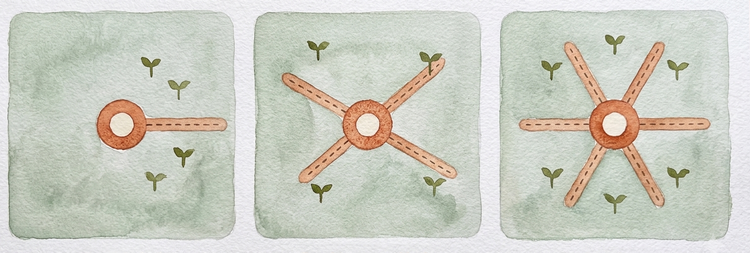
Chapter 9 covers the simplest way to spread the Soil Maker™ Mother Culture — a few new holes near the vessel. Tunnels are an optional next step for actively connecting different spots in your yard into one living network.
THE BASICS
- Dig each tunnel 6 to 12 inches deep and about 6 inches wide, as long as you'd like it to run.
- Use a shovel to scoop Mother Culture and food scraps from the chamber, fill the tunnel about halfway with it, then cover it back over with earth.
- Do this between plants, in the areas where you're planning to grow — not directly on top of existing roots. Keep tunnels 4 to 12 inches from existing plants, at least 10 feet from a mature tree, and at least 4 feet from a young sapling.
PRO TIPS
- There's no required pattern for the tunnels — lay them out however suits your yard.
- While the culture is still establishing, you'll likely only need to do this once or twice. Once it's established and healthy, you may split and spread the Mother Culture four to eight times over the course of the first year, depending on how many food scraps you're feeding it each week.
- The more tunnels you've dug and filled, the more pathways the worms already have to travel on their own, which means less manual emptying for you over time.
- If you'd rather not dig tunnels — or you're generating more food scraps than one vessel can handle — the simplest alternative is to install additional Soil Makers™ around your yard. Spreading Mother Culture from each one gradually connects their underground networks into a single living system over time.
Troubleshooting
A quick reference for the few things that come up most.
"It's been a while and I don't see much happening."
That's normal for the first month while the culture establishes — see Chapter 6 — and slower in cold months. Keep feeding small, consistent amounts.
"There's a smell."
This usually means meat, dairy, oil, or sauced food went in, the chamber was overfilled or packed too tight, or it's gotten too wet — from birdbath water added on top of already-wet scraps, or heavy rain — and has gone anaerobic. Pause feeding for a few days, hold off on adding birdbath water until things dry out, work any packed scraps loose with a stick so air can move through, add cardboard or brown paper, and stick to the approved list.
"It's winter and things have slowed way down."
Expected. Worms move deeper and eat less in cold months. Keep adding scraps at a lighter pace.
"The chamber seems full and I haven't emptied it in a while."
A full chamber is the trigger, not a fixed schedule — go ahead and follow the emptying and spreading steps in Chapter 9 now.
"A hard freeze or snow is coming."
The bowl and lid can crack if water freezes solid inside them. Either bring the top piece in for the season, or leave it in place and cover it with a frost-proof bag until temperatures rise again. The buried chamber below the frost line is unaffected — the culture just slows down until spring.
- Location: 8–10 ft from tree trunks, 1–2 ft from anything planted nearby, 10–15 ft from your door, somewhere you'll actually walk to.
- Digging: twice as deep and wide as the vessel; use a pick for hard/clay soil, then shovel.
- Starting the culture: one can of red wigglers with a couple buckets/bags of food scraps, roughly 50/50 browns to greens, about a month before real breakdown is visible.
- Feed it: vegetable peels, fruit rinds, coffee grounds, eggshells, leafy greens, plain cooked vegetables — up to about 10 lbs/week once established.
- Leave it out: meat, dairy, oils and sauces, large amounts of citrus at once, anything with ink or plastic.
- The rhythm: feed small, consistent amounts; empty and spread once it overflows — that's the trigger, not the calendar.
- Tunnels: 6–12 in deep, 6 in wide; 4–12 in from plants, 10+ ft from mature trees, 4+ ft from saplings; 4–8 cycles in the first year once established.
Questions this guide didn't answer? Visit alchemypot.com/frequently-asked-questions or reach us at connect@alchemypot.com.
Making Compost Tea
A simple way to put the Soil Maker™ Mother Culture to work anywhere in the garden, not just where the vessel is buried.
THE BASICS
PRO TIPS
- This is a great way to feed container plants, indoor plants, or anything too far from a buried vessel to benefit directly.
How It Really Works
Everything up to here has been about actual soil, but soil is just a metaphor for life.
The Alchemy Pot For The Earth
We use the word alchemy to describe transformation — turning waste into soil, both inside and out. That's not just a description of what happens underground in the chamber. It's the whole idea behind Alchemy Pot.
Food Waste → Soil
Heavy Emotions → Connection
When food waste sits packed in a landfill with no air, it doesn't compost — it just sits there and pollutes. Give that same waste air, space, and the right conditions instead, and it transforms into some of the richest soil there is.
We think emotions work the same way. Feelings that never get a safe space to move through you don't just disappear — they pack down the same way waste does in a landfill, and left long enough, that's where disease can take root. But name what you're carrying, process it, and direct that energy into something creative, and it transforms too — the same way food scraps become food for your garden once they're inside the Soil Maker™ instead of buried in a landfill.
That's the full arc behind Make Soil, Inside and Out™: what you do for your garden here, you can do for yourself.
Composting Your Emotions
A simple way to try the other half of the process — the part that happens inside you, not in the ground. Two ways to practice it, below.
Part One — The Alchemy Process. Three short pieces of writing, each one folded up and dropped into the Soil Maker™ alongside your food scraps.
Part Two — Unfiltered Thoughts. This one is your food waste — whatever's actually in your head, before it's been cleaned up.
Both parts work well solo or as a shared activity — in a classroom, at a family dinner, or with a friend. Everyone writes and adds their pieces on the same day.